Written by Andrea Goethals
What we learned by bringing cloud and preservation communities together to discuss portability, sustainability, and shared stewardship of digital heritage.
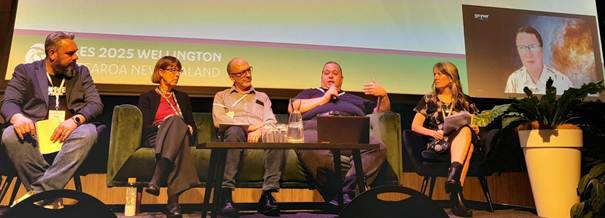
Photo by Carly Lenz. Panelists representing hyperscale cloud, local infrastructure, and preservation-focused services discuss shared approaches to long-term stewardship at iPRES 2025.
At iPRES 2025 in Wellington, we tried a small experiment. The previous year’s panel, Digital Preservation in the Cloud?, focused on the views of libraries, archives and universities grappling with whether and how to use cloud infrastructure for digital preservation. It was both skeptical and optimistic, but undeniably thoughtful. One voice, however, was missing: the people who provide that infrastructure.
So this year we invited them into the conversation, convening the panel “Beyond the Consumer Perspective: Engaging Cloud Providers in Digital Preservation”.
The concept was to crowdsource the questions in advance from the digital preservation community. Instead of putting people on the spot, we gave participants time to propose and vote on questions using the IdeaScale platform.
We were fortunate to have a diverse group of panelists representing hyperscale cloud (AWS and Microsoft), a locally-owned New Zealand provider (Catalyst Cloud) and preservation-focused storage services (Digital Bedrock and Geyser Data). We intentionally chose not to record the session so panelists could speak candidly. We also asked them to avoid product pitches or competitive critiques to keep the discussion constructive and collegial. These instructions were unnecessary – the panelists clearly embraced the spirit of shared exploration.
Here are some of the themes that emerged.
Designing for Exit
If there was one point everyone agreed on, it was this: plan your exit strategy before you start.
Solutions should be designed with the assumption that one day your data will leave. Providers talked about open standards, interoperable formats, and provider-agnostic tooling as the real safeguards against lock-in. Several emphasised that institutions should test migrations and restores, not just assume they will work.
As one panelist put it, “the ideal exit strategy is redundancy in other providers.”
Data Residency is Not Data Sovereignty
Storing data in a country does not automatically mean it is governed there. Panelists distinguished between where data physically resides, who operates the systems, which legal jurisdictions apply, and who can be compelled to access it.
For organisations working with culturally significant material or regulatory obligations, these distinctions matter. Providers discussed region-specific deployments, local partnerships, and customer-managed encryption as ways to support sovereignty requirements.
Certification is a Shared Responsibility
Digital preservation certifications often require documentation about storage infrastructure that is outside an institution’s control.
Panelists recognised that this can’t be left to customers to “figure out.” Providers increasingly supply audit documentation, compliance reports, and technical transparency aligned with ISO and other assurance frameworks, often under nondisclosure agreements to protect security or intellectual property.
That means closer collaboration between repository teams, auditors, and providers – not a black box. As one panelist put it “It’s not easy or fun, but it is necessary. It forces best practice.”
Storage is Cheap – Preservation Isn’t
Another theme that came up repeatedly: the biggest costs in long-term preservation aren’t always where we expect them.
Storage pricing per terabyte has generally fallen over time, and tiered storage models can help manage long-term retention. But panelists pointed out that processing, replication, verification, and management workflows often dominate the real costs.
In other words, preservation economics are driven as much by what we do with the data as where we store it.
To support sustainability, panelists encouraged using lower cost tiers or tape solutions. Some mentioned emerging storage technologies (DNA, glass-based media) that may reshape future cost and environmental models.
Several encouraged institutions to model lifecycle costs across decades, including access, migration, and operational overhead, and to talk openly with providers about pricing assumptions.
Sustainability: Look Beyond the Marketing Slide
Environmental sustainability prompted both agreement and healthy tension.
Large providers highlighted renewable energy commitments, emissions reporting, and third-party certifications. Others stressed that sustainability must be evaluated through measurable practice, not just offsets or headline goals. As one panelist put it “You can’t offset your way to sustainability. Ask what’s being actively reduced, not just what’s being offset.”
The conversation expanded beyond carbon to hardware lifecycle, e-waste, supply chains, labour practices, and infrastructure longevity.
Integrity and Resilience are Shared Work
Cloud platforms already build in redundancy, replication, and integrity checking, but panelists were clear that this doesn’t remove institutional responsibility.
Providers acknowledged the need to support GLAM institutions in independently verifying integrity rather than simply saying “trust us”. The phrase ‘collaborative transparency’ captured this idea – giving institutions the ability to see and test that their content is intact.
Resilience, they noted, is also relational: having trusted contacts when something goes wrong matters just as much as technical architecture.
What Skills Do We Need Now?
The panelists agreed that preservation professionals don’t need to become cloud engineers, but we do need enough technical literacy to ask informed questions, understand service models, have technical staff that can script/automate and understand APIs, do basic cloud system management, and translate preservation requirements into technical reality.
Panelists encouraged us to learn core concepts (object vs. file storage), experiment in training or sandbox environments.
Another emerging skill set is evaluating and using AI and machine learning tools for preservation workflows.
Equally important is building partnerships across our institutions (e.g. with IT staff who are also upskilling in cloud technologies) and with vendors, so we are navigating the cloud in a supported ecosystem.
‘Partners’ Instead of ‘Vendors’
The conversation suggested moving away from a purely transactional model (we buy storage from you), toward something closer to shared stewardship.
Many traditional concerns about cloud adoption – loss of control, opacity, dependency – are increasingly being addressed through architecture, standards, and dialogue rather than avoided outright.
At the end of the session, it was clear that hyperscale cloud, local infrastructure, and alternative storage approaches are not competing answers but complementary tools, each suited to different contexts.
At the end of the day, this panel experiment was successful: we were able to learn from each other, and several panelists expressed a desire to continue the discussion.
A Panelist’s Reflection on What Comes Next
One panelist later shared a written reflection that captures many of the collaborative ideas raised during the discussion and points towards practical next steps. We include it here in full because it offers a useful roadmap for future engagement between our communities:
“To bridge the gap between commercial providers and the open digital preservation community, we need to cultivate a culture of mutual transparency and learning. First, cloud providers can participate in community forums (like this panel, iPres, DPC events) not to market products, but to share technical insights and listen to the community’s needs. For example, providers might publish case studies or white papers about preservation projects (with permission), including the challenges faced and how they were resolved – offering candid lessons learned rather than just success stories. Likewise, when research groups or memory institutions innovate (say, develop a new fixity tool or preservation workflow), those findings should be shared openly so that cloud engineers can consider them for platform improvements. Open-source collaboration is a great mechanism here: if a preservation community develops a tool, cloud companies can contribute code or at least ensure their platforms work well with it, and conversely providers might open-source certain utilities that institutions can adopt and modify. In the realm of security and resilience, it’s especially vital to share information: if, for instance, a cloud provider encounters a novel cyber threat, disseminating that knowledge (in appropriate ways) to customers and even competitors means everyone’s data is safer. We should also encourage more public–private partnerships — maybe joint task forces on digital preservation challenges where both archives and cloud architects sit together (for instance, tackling the issue of preserving complex cloud-based interactive content, or defining standard APIs for fixity across systems). The underlying principle is trust: by demonstrating openness and a willingness to learn from each other, commercial and non-commercial entities can move beyond a vendor-customer dynamic to a more collaborative one. This might involve some mindset shifts on both sides (companies being more candid, and institutions being open to dialogue), but it will strengthen overall resilience. The digital preservation community thrives on openness and shared knowledge, so we want to extend that ethos to include cloud providers as true partners in preserving our digital heritage. Each side has expertise to offer, and by sharing insights and innovations in good faith, we collectively ensure the longevity and safety of information in an uncertain world.”
That reflection reinforces the central message of the panel: digital preservation and infrastructure providers are no longer operating in separate spheres, but are learning how to design sustainable solutions together.
Acknowledgments
A special thank you to our service provider partners who agreed to participate: Linda Tadic (Digital Bedrock), Bevan Sinclair (Microsoft), Kevin Thomas (Geyser Data), Terence White (AWS), Paul Seiler (Catalyst Cloud).
Thanks to everyone who submitted questions for the panel – you know who you are!
And thanks to Abby Wolf for helping plan the panel, Carly Lenz for serving as timekeeper and photographer, and Jane Mandelbaum and Rachel Tropea for sharing their notes.